Showing posts with label currency. Show all posts

Monday, 9 October 2017

How Cryptocurrency Works

Put simply, cryptocurrency is digital money, which is designed in a way that it is secure and anonymous in some instances. It is closely associated with internet that makes use of cryptography, which is basically a process where legible information is converted into a code that cannot be cracked so as to tack all the transfers and purchases made.
Cryptography has a history dating back to the World War II, when there was a need to communicate in the most secure manner. Since that time, an evolution of the same has occurred and it has become digitalized today where different elements of computer science and mathematical theory are being utilized for purposes of securing communications, money and information online.
The first cryptocurrency
The very first cryptocurrency was introduced in the year 2009 and is still well known all over the world. Many more cryptocurrencies have since been introduced over the past few years and today you can find so many available over the internet.
How they work
This kind of digital currency makes use of technology that is decentralized so as to allow the different users to make payments that are secure and also, to store money without necessarily using a name or even going through a financial institution. They are mainly run on a blockchain. A blockchain is a public ledger that is distributed publicly.
The cryptocurrency units are usually created using a process that is referred to as mining. This usually involves the use of a computer power. Doing it this way solves the math problems that can be very complicated in the generation of coins. Users are only allowed to purchase the currencies from the brokers and then store them in cryptographic wallets where they can spend them with great ease.
Cryptocurrencies and the application of blockchain technology are still in the infant stages when thought of in financial terms. More uses may emerge in the future as there is no telling what else will be invented. The future of transacting on stocks, bonds and other types of financial assets could very well be traded using the cryptocurrency and blockchain technology in the future.
Why use cryptocurrency?
One of the main traits of these currencies is the fact that they are secure and that they offer an anonymity level that you may not get anywhere else. There is no way in which a transaction can be reversed or faked. This is by far the greatest reason why you should consider using them.
The fees charged on this kind of currency are also quite low and this makes it a very reliable option when compared to the conventional currency. Since they are decentralized in nature, they can be accessed by anyone unlike banks where accounts are opened only by authorization.
Cryptocurrency markets are offering a brand new cash form and sometimes the rewards can be great. You may make a very small investment only to find that it has mushroomed into something great in a very short period of time. However, it is still important to note that the market can be volatile too, and there are risks that are associated with buying.
Article Source: Here

Thursday, 5 October 2017

Buying Into Bitcoins

With the 21st century demand for quick and big profits, one of the most controversial new investment vehicles has been Bitcoins, the virtual currency. It's gained controversy partly because of its volatility, partly through the instability of Bitcoin exchanges and partly because their in-traceability meant they were a favored payment method for criminals.
Things are changing and after a particularly volatile spell in which one of the main exchanges, MtGox, filed for bankruptcy, the currency seems to have settled into a more stable pattern allowing investors to be able to take a measured view of whether to risk their money in a currency that technically doesn't exist.
Volatility
Although Bitcoins are becoming increasingly popular, the market is still quite small, meaning that good and bad news can have a disproportionate effect on the price. The long term outlook for Bitcoins is potentially good, meaning that the upside on price is stronger than the potential for a decline over the long term. Most brokers recommend that you consider Bitcoin a medium to long term investment because of its volatility. Think of it in terms of real estate. No one buys and sells houses many times a day and there can be significant drops in property prices but the long term trend for property prices is usually up. The same can be said for Bitcoins. Whilst there is a significant daily trade in the currency, many Bitcoins are held as investments as analysts believe that it's likely the price of Bitcoins will rise long term because they are becoming more widely accepted.
Influencers
As with all financial instruments, prices are influenced by supply and demand. Bitcoins are no different but what has caused big fluctuations in price has been the unusual nature of the news that influenced the supply and demand:
• The bankruptcy of MtGox, one of the biggest Bitcoin exchanges
• The closing down of Silk Road which allegedly accepted Bitcoins for drug trading
• The disclosure by the US government that, despite the negative uses of Bitcoins, they believed that the currency had a future
• The media has also stirred up interest by reporting on milestones in the currency's rise and fall, trumpeting the rise to over $1000 and its subsequent plummet on bad publicity.
Generally the advice on investing in Bitcoins is to sit and watch the market for a couple of weeks to get an idea of how the currency trades, its volatility and trends. It's difficult to find rumor that hasn't instantly affected the value, so many suggest investing a small amount and simply watching for opportunities, a little like setting take profit levels with shares and Forex, you can do the same on Bitcoins; it's just a bit longer process and a little less automated.
Just like with any investment, the value can fall, and events like the collapse of MtGox and the closing down of Silk Road, negatively affected Bitcoins; not just because demand was reduced but also because Bitcoins were falsely linked with the companies by urban myth. The market seems to be becoming more regular, but not necessarily regulated, as more exchanges come online. Some of the exchanges will go the same way as MtGox but others will consolidate and become stronger and more reliable. No doubt official regulation will be applied to Bitcoins in due course at which time the volatility is likely to reduce.
Bitcoins represent an exciting and potentially lucrative medium to long term investment vehicle. Exciting because it hasn't yet been accepted into the mainstream of currencies or investment vehicles. One thing investors like about Bitcoins is their conviction to prospects as was in gold


Article Source:Here

Monday, 2 October 2017

The ABC of a Successful Trader

Day traders use Bollinger Bands® as a technical indicator to display a chart reading of volatility by how tight they are around a financial instrument. The degree of tightening or widening them surrounding the price action of a financial instrument determines the level of volatility. Chart facing, a 21-day moving average (preferred period of time) is surrounded by an upper and lower Bollinger Band®. They are meant to serve as a technical indicator of overbought (wide bands) and oversold (tight bands) market conditions.
How Are Bollinger Bands® Read?
Looking at financial instrument charting software with 'tight' Bollinger Bands® applied to the price action, a significant move to the up or down side may occur soon. However, if a financial instrument chart has 'wide' bands applied to price action, this may signal a significant move is not likely to occur in the not too distant future. Tight and wide, they can also be used as a counter technical indicator of both potential low and high volatility in that present price action is used to predict a different, future market move.
With the above said, the best conditions for the indicator's use are periods of low volatility with scant price fluctuation. The more time passed in a low volatility environment, the more they will tighten around a financial instrument's price action. When tightening more than usual, the bands may be signaling an increase in future volatility.
How Can Bollinger Bands® Be Used?
When analyzing Bollinger Bands® with the intention of day trading online, do not rush to make a decision if price action breaches the top or bottom band, as this is not always an indication of an immediate market move. That said, though most price action movement occurs within the indicator, a breach of an outer band is a rare occurrence indeed, but cannot be relied on to be a guaranteed buy/sell signal. In addition, though widely used, Bollinger Bands® are actually meant to be used in tandem with two or more other technical indicators such as Relative Strength Index (RSI) and MACD.
It is important to note, before day trading based on a signal derived from Bollinger Bands® and two other indicators, backtesting historical market trends with all of these indicators is strongly suggested. Backtesting these indicators against the historical market trend you are focusing on will provide an idea of how your strategy would have performed in historical market conditions.
Brian Horowitz writes Forex and futures trading articles at featuring examples of how technical indicators can potentially be used to trade financial markets.
Article Source: http://EzineArticles.com/expert/Brian_Horowitz/2376438


Article Source: http://EzineArticles.com/9625377
Forex Trading is built upon appropriately educated, disciplined and self-controlled individuals whose years of expertise in the field of Foreign Market Exchange has led to true mastery of trading skills. A successful trading business functions much like a team of highly adept soldiers: Like good soldiers, professional traders must visualize the battle before entering into the fight with their opponents. To secure victory both soldier and trader alike must take the proper steps before diving into action.

The "Holy Market" and its "Commandments"

Market treats all traders equally as such; it is the accurate implementation of strategy that determines the fate of a trader. Being a successful trader is an indication of outstanding work being done hours before markets open as well as long its working, simply in booking profits and controlling urges fore example that relentlessly instruct you to "go back in and make some more money"

Preparation is half the battle

The key to successful trading is good planning. A great trader is a person who knows exactly what he is looking for. He will put in the time and effort required to research and develop strategic plans that encompass short- and long-term goals.
Planning includes establishing a list of the actions required for a successful trading day, namely one that is set to yield profits. The first step is to review the trading journal of the previous day to prepare for the next trade. The second step is to perform a chart analysis to find out which currency pairs you will follow. Finally, the third is to prepare your trading platform; do so by reading the latest global economic data from the international economic calendar. This will reveal whether the currencies you are monitoring have been affected by the latest economic developments.

Develop your trading sense

Having the dexterity to trade is an advantage for any trader, but such skills can take years of practice to develop. Most traders use their "6th sense" to spot and grab opportunities of small price discrepancies both within and between the markets.
Much like a manager, the trader has to rely both on analysis and his intuition to spot the trade set ups at the right moment. However, a novice trader can still develop this sense and make consistent money by rigidly following the principle of risk and reward in Forex trading. This principle demands careful study of what the trader is going to risk.

Discipline 100%
The best traders are intensely self-aware. They know their limitations and focus on what can go wrong by investing their energy in limiting and controlling their risk.
To achieve success in Forex Trading, the most essential step of all is to stick your strategy. A carefully laid plan will guide the trader through the fundamental and technical analysis required to interpret the price movements, translate the technical indicators, and identify the ideal trading positions. A good trader is a disciplined trader; he is like a hunter, preparing for days to achieve the perfect trading set up. He chooses an appropriate stop loss point which marks the amount of acceptable risk; he never allows more than the most efficient amount of risk. He is never gripped by greed, fear, hope or regret and does not exaggerate his expectations of success. His excellent decision-making skills prevent the opinions of others from leading him astray, and he does not over-analyze or over-trade. Despite his success, he remains humble and always provides honest guidance to novice and fellow traders.

Detach from the need of money

Successful traders view trading as an exercise, and they focus on getting the most out of the market in accordance with their plan. In short, a good trader should not be motivated by financial reward. If this rule is broken, as it unfortunately often is, the market will turn and move against any trader who has an excessive desire for money.
Greed is the main enemy of all traders. It presents a profound hurdle on the way to the success. Desire for possession must never govern a trader's actions; the results of such loss of control are always catastrophic. In small part, trading is an opportunity to make money in a certain amount of time if all rules are obeyed. However, it is also a chance for self-fulfillment and a test of one's worthiest capacities, and it must be respected as such.

Stand strong like a rock

A good trader must stick to the rules of his strategy. He must not allow emotions like greed, fear, hope and regret to overtake him; these in particular are the four worst emotions for a trader. Consistently profitable traders have an unshakable emotional system regardless of conditions.
Like greed, dealing with emotions during trading is also a constant challenge. The first thing that a trader must do is follow a strategy that is comfortable for him. To avoid emotions, the trader has to enter trading with realistic expectations; bet a logical amount of money on a trade; and learn to enjoy trading by risking less money, gaining experience, and developing belief in his strategy.

Adapt to change

The very best traders are always eager to learn and improve their skills to keep up with the continuing changes in the market and technology. A trader should be flexible enough to cope with the technological advances and read intensively.
In the constantly changing Forex environment, the trader must be flexible. If the market throws something unexpected at him, the trader should be able to analyze it and take action quickly. Success in the Forex market demands a non-stop learning process through which traders come to understand the volatility of the market and in return gain the expertise needed to make profits.

Good decision-making skills

A successful trader must possess excellent decision-making skills. Once you realize that your trade is going to close at a loss, exit immediately. Successful trading is mainly based on good decision-making and is highly related to the relevance of the present data collected. Successful traders are also independent in their decision making.
The primary difference between the professional Forex trader and the beginner is that the first knows exactly what he is looking for and when to enter the market.
Successful Forex brokers who gain recognition respect each of these rules. They work hard to be successful and even harder to stay in front and remain profitable. They know that the market will reject those who disobey these rules in favor of money because trading is a practice of passion not of greed.

The successful trader

George Soros gained international recognition when he toppled the Bank of England on September 16, 1992, a day that is preserved in history as "Black Wednesday". He was given the nickname "the man who broke the Bank of England" because Britain was then forced to abandon the Exchange Rate Mechanism aimed at fixing the pound's rate to the Deutschmark.
Soros risked $10 billion and generated $1 billion in profit in a single day.
"The money that I made on this particular transaction would be estimated at about $1 billion. We very simply used the forward market-you borrow sterling and you sell the sterling that you have borrowed. And then you buy back the sterling when the loan expires". (Soros, 1992)
George Soros was also accused of triggering the Asian financial crisis by selling the Thai baht and Malaysian riggit short in 1997. Thailand proactively spent almost $7 billion to protect the baht against speculators and finally asked the International Monetary Fund for its help. In The Crisis of Global Capitalism: Open Society Endangered, Soros (1998) responded, "The Prime Minister Mahatir of Malaysia accused me of causing the crisis, a wholly unfounded accusation... We were not sellers of the currency during or several months before the crisis; on the contrary... we were purchasing ringgits to realize profits on our earlier speculation".
Soros gained more than $790 million in this trade. "It's not whether you're right or wrong that's important, but how much money you make when you're right and how much you lose when you're wrong", he summarizes.

The 3rd most notorious trade that Soros ever made came in 2012, when he recognized the possibility that the yen could go down after the damage that Japan's economy had suffered during the devastating tsunami of 2011. Sure enough, the yen did indeed weaken, and when it did, in order to boost the economic situation, many speculators opened USD/JPY positions betting that the value of the dollar would rise against the yen. In this case, Soros gained $1.4 billion.
The main technique of Soros and other top-notch traders is to spot upcoming vulnerabilities in a country and then go right after currency before it falls. A currency pays off better when its rate is fixed in relation to other currencies, as in the case of the pound and Thai baht.
Vulnerable countries try to buy up their currency when it is being sold, as people can turn around and sell the currency themselves.

These countries do so in an effort to artificially sustain the fixed rate. However, this artificial balance is very sensitive, and when the countries cannot fight the market forces any longer, the balance collapses. This is exactly what happened in the Soros cases.
As Soros demonstrates, a threat for others can turn into a profound opportunity for traders who are alert and prepared to act. Soros is an example of a good soldier who used his disciplined mindset, an analytical approach, and all his market commandments to become a successful currency trader. He both masterfully and calmly conducted himself within the currency war market and demonstrated a combination of patience with discipline to identify the perfect time to execute his trades. Clearly, an adept soldier's qualities can become the qualities of a great currency trader as well.
 

Saturday, 23 September 2017

Bitcoin - Big Businesses That Accept Bitcoin

Bitcoin is a hot! It rose to $5480.68 per coin recently! People are scrambling to get hold of it. But, can you actually pay for things with this digital cash? Yes! This is by no means all of the businesses accepting Bitcoin, but it is an interesting list of big names to show you that it is now a serious currency to consider owning...
  • Dell now accepts Bitcoin. They have a partnership with Coinbase, one of the most trusted exchanges.
  • DISH Network - Internet service provider
  • Newegg - Huge retailer of computer electronics and hardware
  • Microsoft - Add money to your account with Bitcoin to buy apps, games, and videos.
  • TigerDirect - California-based retailer that offers electronics, computers, and computer components that caters to business and corporate customers.
  • Virgin Galactic - The Richard Branson-led aviation company started accepting Bitcoin for customers who are interested in flying to space and paying for it using Bitcoin.
  • WordPress - The popular blogging platform used by some of the biggest media companies in the world has accepted Bitcoin since 2012.
  • The Pirate Bay - A huge BitTorrent director with a large library of movies, television shows, software, and music started accepting Bitcoins in April 2013.
  • Reddit - Reddit allows users to purchase Reddit Gold using Bitcoins.
  • Zynga - A popular mobile gaming company loves Bitcoin.
  • OkCupid - The online dating site started accepting Bitcoin for premium services in April 2013.
  • Memory Dealers - Carries a large range of networking hardware equipment and computer memory.
  • CheapAir - This California-based online travel booking website started accepting bitcoin in November 2013.
  • The Sacrament Kings NBA franchise takes Bitcoin for food, clothing, and beer.
  • Namecheap - This service offers inexpensive domain registration. It started allowing customers to pay with Bitcoin in 2013.
  • Intuit - an American software company that develops financial and tax preparation software and related services for small businesses, accountants and individuals.
  • Bloomberg.com - Online newspaper
  • PizzaForCoins.com - Domino's Pizza signed up
  • Steam - Desktop gaming platform
  • Subway - Eat fresh
  • A Class Limousine - Luxury service will pick you up.
  • Suntimes.com - Chicago based online newspaper
  • Rakutan - A Japanese e-commerce giant
  • MovieTickets.com - Online movie ticket exchange/retailer
  • Yacht-base.com - Croatian yacht charter company
  • Expedia.com - Online travel booking agency
  • Save the Children - Global charity organization
There are thousands more and hundreds of thousands to come. Bitcoin is just an infant. More and more businesses will realize the value of this magic currency soon. Many wealthy investors are buying it up like crazy. Maybe they know something the general public needs to know!


Article Source: Here

Friday, 22 September 2017

What Are Top 5 Cryptocurrencies Other Than Bitcoin?

Bitcoin has lead the crypto world for so long, and so dominantly that the terms crypto and Bitcoin are often used interchangeably. However, the truth is, the digital currency does not only comprise of Bitcoin. There are numerous other crypto currencies that are part of the crypto world. The purpose of this post is to educate our readers on cryptocurrencies other than Bitcoin to provide them with a wide range of options to choose from - if they intend on making crypto-investments.
So let's get started with the first name on our list, that is:
Litecoin:
Launched in 2011, Litecoin is often referred to as 'silver to Bitcoin's gold.' Charlie Lee - MIT graduate and former engineer at Google - is the founder of Litecoin.
Similar to Bitcoin, Litecoin is a decentralized, open source payment network which functions without a central authority.
Litecoin is similar to Bitcoin in many ways and often leads people to think: "Why not go with Bitcoin? Both are similar!". Here's a catch: the block generation of Litecoin is much faster than that of Bitcoin! and this is the main reason why merchants around the world are becoming more open to accepting Litecoin.
Ethereum:
Another open source, decentralized software platform. The currency was launched in 2015 and enables Smart Contracts and Distributed Applications to be built and run without any downtime.
The applications on Ethereum platform require a specific cryptographic token - Ether. According to the core developers of Ethereum, the token can be used to trade, secure, and decentralize just about anything.
Ethereum experienced an attack in 2016 which saw the currency split into two parts: Ethereum and Ethereum Classic.
In the race of leading cryptocurrencies, Ethereum is second most popular and is right behind Bitcoin.
Zcash:
Zcash came out in the later part of 2016. The currency defines itself as: "if Bitcoin is like http for money, Zcash is https".
Zcash promises to provide transparency, security, and privacy of transactions. The currency also offers the option of 'shielded' transaction so the users can transfer data in the form of encrypted code.
Dash:
Dash is originally a secretive version of Bitcoin. It is also known as 'Darkcoin' due to its secretive nature.
Dash is popular for offering an expanded anonymity which allows its users to make transactions impossible to trace.
The currency first appeared on the canvas of digital market in the year 2014. Since then, it has experienced a large fan following over a very short span of time.
Ripple:
With a market capitalization of over $1bn, Ripple is the last name on our list. The currency was launched in 2012 and offers instant, secure, and low-cost payments.
The consensus ledger of Ripple doesn't require mining, a feature which makes it different from Bitcoin and other mainstream crypto currencies.
The lack of mining reduces the computing power which ultimately minimizes the latency and makes transactions faster.
Wrap Up:
Although Bitcoin continues to lead the pack of crypto, the rivals are picking up the pace. Currencies like Ethereum and Ripple have surpassed Bitcoin in enterprise solutions and are growing in popularity each day. Going by the trend, the other cryptos are here to stay and will soon be giving Bitcoin a real tough time to maintain its stature.


Article Source: Here

Monday, 18 September 2017

Buying Into Bitcoins

With the 21st century demand for quick and big profits, one of the most controversial new investment vehicles has been Bitcoins, the virtual currency. It's gained controversy partly because of its volatility, partly through the instability of Bitcoin exchanges and partly because their in-traceability meant they were a favored payment method for criminals.
Things are changing and after a particularly volatile spell in which one of the main exchanges, MtGox, filed for bankruptcy, the currency seems to have settled into a more stable pattern allowing investors to be able to take a measured view of whether to risk their money in a currency that technically doesn't exist.
Volatility
Although Bitcoins are becoming increasingly popular, the market is still quite small, meaning that good and bad news can have a disproportionate effect on the price. The long term outlook for Bitcoins is potentially good, meaning that the upside on price is stronger than the potential for a decline over the long term. Most brokers recommend that you consider Bitcoin a medium to long term investment because of its volatility. Think of it in terms of real estate. No one buys and sells houses many times a day and there can be significant drops in property prices but the long term trend for property prices is usually up. The same can be said for Bitcoins. Whilst there is a significant daily trade in the currency, many Bitcoins are held as investments as analysts believe that it's likely the price of Bitcoins will rise long term because they are becoming more widely accepted.
Influencers
As with all financial instruments, prices are influenced by supply and demand. Bitcoins are no different but what has caused big fluctuations in price has been the unusual nature of the news that influenced the supply and demand:
• The bankruptcy of MtGox, one of the biggest Bitcoin exchanges
• The closing down of Silk Road which allegedly accepted Bitcoins for drug trading
• The disclosure by the US government that, despite the negative uses of Bitcoins, they believed that the currency had a future
• The media has also stirred up interest by reporting on milestones in the currency's rise and fall, trumpeting the rise to over $1000 and its subsequent plummet on bad publicity.
Generally the advice on investing in Bitcoins is to sit and watch the market for a couple of weeks to get an idea of how the currency trades, its volatility and trends. It's difficult to find rumor that hasn't instantly affected the value, so many suggest investing a small amount and simply watching for opportunities, a little like setting take profit levels with shares and Forex, you can do the same on Bitcoins; it's just a bit longer process and a little less automated.
Just like with any investment, the value can fall, and events like the collapse of MtGox and the closing down of Silk Road, negatively affected Bitcoins; not just because demand was reduced but also because Bitcoins were falsely linked with the companies by urban myth. The market seems to be becoming more regular, but not necessarily regulated, as more exchanges come online. Some of the exchanges will go the same way as MtGox but others will consolidate and become stronger and more reliable. No doubt official regulation will be applied to Bitcoins in due course at which time the volatility is likely to reduce.
Bitcoins represent an exciting and potentially lucrative medium to long term investment vehicle. Exciting because it hasn't yet been accepted into the mainstream of currencies or investment vehicles. One thing investors like about Bitcoins is their conviction to prospects as was in gold


Article Source: Here

Friday, 8 September 2017

3 Tips On How To Consistently Make Profits In The Forex Market

It's the dream of every Forex trader to make profits consistently. The unfortunate thing is that very few traders are able to make consistent profits. If you would like to make profits in the market here are tips that you should put into consideration:
Select A Trading Style And Stick With It
There are many styles of trading that you can use. The most popular ones are:
Scalping: this is where you open a trade for just a short period of time (less than five minutes) with the aim of eking out a small profit.
Day trading: here you open a position and you let it last the whole day. When it comes to closing it, you close it at a specific time. As a trader, you should use this style when you are interested in making huge profits. Although, you stand to make good amounts of money using this style, it's very risky if it goes against you.
Trend trading: you hold positions for days or even weeks.
Carry trade: this is where you buy high-yield currencies and sell low-yield ones. Carry trades can last for months.
You should do your research and settle on the style of trading that is ideal for you.
Be Disciplined
Discipline is important in every part of life. For you to be disciplined in Forex trading you need to know what you want in a trade. You also need to stick to your limits. To have an easy time you should have a Forex trading journal. The journal will help you in tracking your trades so that you can be disciplined.
You also need to protect your trades. Here you need to keep an eye on three prices: entry price, stop-loss price and that take-profit price. To protect your trade you should always set your stop-loss price closer to the entry price.
Do not Concentrate On Making Money
While money is very important, you should avoid concentrating too much on it-you should concentrate on trading. This calls for you to stay in a comfortable area where you will fully concentrate on the trade. You should also concentrate on your trading strategies.
Conclusion
These are tips that you need to put into consideration if you want to consistently make profits in the Forex market. Before you start trading with real money always ensure that you first master how to trade using a demo account.

Article Source:Here

Thursday, 7 September 2017

5 Things To Be Wary Of When Working With A Forex Broker

A Forex broker is of great importance for you to be successful in the Forex market. Due to this, you need to be very cautious when hiring a broker. Here are some of the things that you need to be wary of:
Guaranteed Profits
If you come across a broker promising to give you 30% or 40% return in two months, chances are that the broker is promising something that he/she can't deliver. These claims of giving you massive profits are false and are tricks to lure you into investing your money with the broker.
Lose Recovery
It's common to find some brokers saying that they will help you in recovering any loses that you make in the Forex market. This is usually false. Remember that the Forex market is very risky and you may end up losing all or part of your money. To be on the safe side you should never trade an amount that you can't afford to lose.
Interbank Market
You will most likely come across some brokers who will try to lure you into trading in the interbank market so that you can get more money. You should never invest your money in this market as only speculative and short-term currency transactions are negotiated. In addition, unstable network of banks and large companies participate in these negotiations.
Performance Record
Before you make a decision on whether to work with a given Forex broker, you should ask the broker to give you his/her performance record. All reputable Forex brokers are members of NFA or CFTC; therefore, you should always countercheck the information that the broker gives you.
If you ask a broker for his/her track record and he/she fails to give it to you, you shouldn't invest your money with him/her. You should also avoid working with a broker who isn't registered with CFTC or NFA.
Comments
Users usually leave comments on the websites of the brokers. You should visit the comments section and read what different people have to say. If all the comments are positive, chances are that the broker is trying to play games with you. You should try commenting and see if the comment appears on the site. For ideal results, you should leave a negative comment. You should keep track of the comment and find out if it remains on the site.
Conclusion
These are some of the things that you need to be wary of when working with a Forex broker. As rule of thumb you should avoid any broker with questionable behavior.


Article Source: Here

Friday, 4 August 2017

Nonfarm Payrolls Preview: NFP can't save the not-so-mighty dollar

Another week is almost over, with the EUR/USD pair having flirted with 1.1900 for the first time in over two years and the greenback mixed across the board, but still weak. The American currency only gained these last few days against currencies that eased on self-weakness, as the negative sentiment towards the greenback remains intact. If anything, chances of a rate hike in the US have decreased further on dovish comments from Fed's officers, while political jitters keep coming as President Trump seems unable to focus beyond the Obamacare repeal bill and North Korea, still struggling to form a reliable team around him.
Traders have one more milestone to surpass this week that is, the US monthly employment report, to be release this Friday. The country is expected to have added 183K new jobs in July, after June's positive surprise of 222K. The 4.4% unemployment rate is still expected to drop to 4.3%, while average hourly earnings are expected to be up 0.3% monthly basis, and by 2.4% on the annualized figure, this last, slightly below previous 2.5%.
The ADP survey released on Wednesday showed that the private sectors added 178,000 new jobs last month, just below forecasts for of 185,000, while June reading was upwardly revised to 191,000 from an initial estimate of 158,000, neutralizing the slightly negative headline, and somehow anticipating a solid US employment report, but would it matter?
There's has been long since the US Nonfarm Payroll report triggered interesting market movements, except in the case of big disappointments, quite logical given the ongoing distrust in dollar's future. And that will be the case for this Friday: the NFP report will only be relevant if it's a big miss.
All components will be relevant, but jobs' creation and wages will take center stage, as slow wage growth will maintain inflation subdued, and with poor inflation, there are no rate hikes in the Fed's book.

EUR/USD levels to watch

There is one reason why a strong report can trigger a downward move in the EUR/USD pair: the market can take it as a reason to take profits out of the table ahead of the weekend. Yet after the dust settles, probably early next week, the common currency could resume its advance.
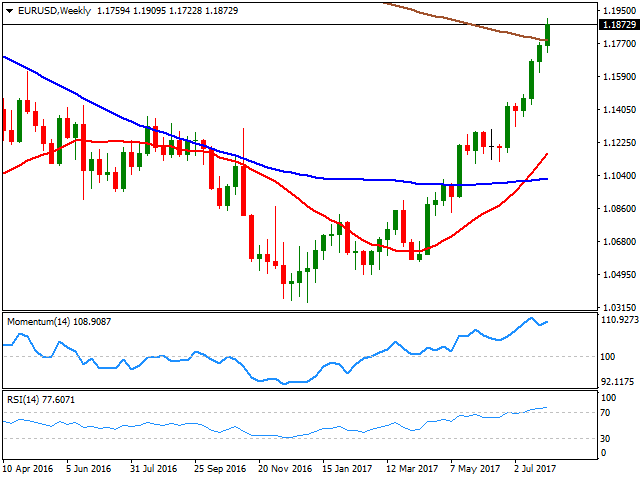
The EUR/USD pair stands a handful of pips below its yearly high, up for a third consecutive week, and pretty much advancing since mid April, resulting in overbought conditions in daily and weekly charts, another reason why a pullback can't be dismissed. At the same time, there´s no sign of upward exhaustion, which means that the rally can extend on a lousy report.
The weekly chart shows that the price is now above its 200 SMA, the first time since July 2014, while technical indicators maintain their upward slopes within overbought territory. In the daily chart, the RSI indicator keeps heading higher around 75, while the Momentum indicator consolidates near its recent record highs, as all of the moving averages head north far below the current level, all of which supports more gains ahead.
Beyond 1.1910, the next resistance comes at 1.1950, followed by the critical 1.2000 threshold, where the market can also rush to take profits out of the table. To the downside, 1.1830 is the immediate support, with a more relevant one at 1.1785. Below this last, the corrective movement can extend down to 1.1715, August 2015 high, without affecting the dominant bullish trend. 

Simple Three Step Bollinger Band Strategy That Makes Money

Top professional traders all over the world use this system to trade. It works on any time frame but produces better results on the longer...